
Second graders meet Marshfield Airport up close

Dozens of excited second graders from Chandler Elementary School in Duxbury visited Marshfield Municipal Airport over the past couple of weeks for tours, learning sessions, and hands-on time in the cockpits of actual airplanes. While they didn’t go up in the air in the planes, they got in plenty of fun time on their field trip pretending to take off, pitch and roll, and land.
Shoreline Aviation staffers split the bus loads of pupils, teachers, and chaperones over the multi-day visits into small groups so they could all get special attention. Shoreline manages the airport for the town.
Airport Assistant Manager Ben Garman tested pupils with questions about early aviation that led them right to Marshfield Airport. After setting the scene with info about the Wright Brothers, who gave the aviation industry liftoff, he asked who the first person was to fly solo across the Atlantic Ocean. First answers were Amelia Earhart, who was the first women to make a nonstop solo transatlantic flight. The correct answer, however, was Charles Lindbergh. And the local connection is the fact that Marshfield was the last American soil he saw on his flight to Europe. A plaque in the airport’s yard commemorates the event.
Ben, line technician Chris Davis, flight instructor and charter pilot Alex Doyle, and Shoreline General Manager Travis Barth, along with South Shore Flying Club board member Karl Swenson, handled the tour guide duties on this particular day. Each used questions to get the kids participating and exploring their creative minds.

Shoreline Aviation General Manager Travis Barth describes aircraft parts to visiting pupils, teachers and chaperones.
Learning to fly
Alex talked with her groups about teaching people how to fly. She taught the kids about the training necessary for instructing as well as for earning a private pilot’s license. She also surprised many pupils when she told them that people can take flying lessons starting at age 13. They can earn a student pilot’s certificate at 16 and even fly solo then.
She also talked about flying charter, in terms an 8-year-old child can grasp. “When we fly charter flights, such as to Nantucket, we don’t have to deal with people in the road. But we have to deal with people in the sky. Do you know who we talk to in the sky? We talk to air traffic controllers, who tell us what we can do if there’s any traffic in our vicinity.”
Alex also described what goes into making a plane, which the second graders saw up close with Ben and Karl.

South Shore Flying Club board member Karl Swenson poses with second graders by the club’s Piper Archer airplane.
Hands on
Karl arranged for the South Shore Flying Club to show its planes stored in hangars at the airport, a Piper Archer III low wing and a Cessna 172 Skyhawk high wing, which are maintained by Shoreline’s Maintenance Department.
Put a youngster behind a steering wheel – or, in a plane, the yoke – and the natural instinct is to steer it. With much enthusiasm! And a yoke is much more than a steering wheel, such as a child would see in a car. It controls turning left and right (roll), like a steering wheel, but it also controls the plane’s climbing and descending pitch.
Karl told each set of pupils sitting in the two pilot seats of the Cessna, that a light touch is needed to control the plane.
“You do things very gently,” he said. “Sometimes we just use two fingers to steer. You push the throttle in to go fast, and then you pull the yoke back to take off. The yoke controls the pitch (nose up and down for climbing and descending) and roll (turning left and right).”
He also described the jobs of the various instruments on the panel. “All these instruments tell us where we are and where we’re going, how fast we’re going, how fast we’re going up and down, whether we’re level to the earth, and how high we are. We also do a lot of radio work.”
Karl coached his kids through maneuvers. “Level off, turn gently, you’ve got it. Now you’re flying straight. Let’s see you turn to the left now. Whoops, that’s a hard turn. Right now you’re almost tipped up on your side, so now level off again.”
The kids were enthralled!
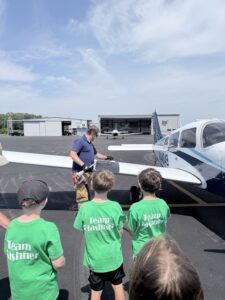
Airport Manager Jason Tibbetts shows visiting second graders how to fuel an airplane.
Equipment management
Travis provided tours of the equipment stored in Shoreline’s jet hangar. Two full wall doors allow for the jets to be moved in and out of the hangar, and a small door is used to move support equipment in and out. He also described how Shoreline keeps the aircraft nice and clean for passenger comfort, and that they maintain drinks and snacks for passengers, similar to commercial aircraft.
He described the air conditioning units that blow cool air into a jet, whose AC hasn’t been running, and how Shoreline’s ground power unit is used to power on the aircraft, so that heavy burden would not have to fall on the planes’ batteries.
He also described to the kids a piece of hydraulic equipment designed to lift a wheel in the air to change a flat tire and another, called a tug, used to lift the nose wheel and move the plane. Shoreline has two.
“These tugs are used to move the planes, like a tugboat,” he said. “It grabs ahold of the nose wheel and pulls it along. That’s how the planes go into the hangar. Pilots don’t fly them into a hangar. Everybody gets off the plane out there, and the line crew brings it into the hangar with a tug.”

Second graders wave as a single-prop airplane takes off on Runway 24 at KGHG.
Groundside operations
Ben and Chris wrapped up with additional insights. “There’s the airside operations – the airplanes, the pilots,” Ben said. “And then there’s the groundside operations, for airfield management, the day-to-day operations we do that not too many people know about.”
He pointed to the large tractor and attached mower, the big Marsh Master (a rugged amphibious track vehicle), and the plow trucks.
“We have to maintain approaches around the airport so airplanes can land,” he said. “And the Marsh Master is designed to work in wetlands and go through the water.”
Ben also described the two fuel trucks, one for jet fuel, one for gasoline engine planes.
Lastly, Ben showed the kids a peculiar long funnel looking shape. “The windsock shows wind direction. It points in the direction the wind is blowing. Pilots like to land into the wind and take off into the wind, which gives the planes lift.”

The airport’s tractor mower is kept busy all summer.
This was one of several days of airport tours, which Shoreline conducts annually.
“Today was a fantastic day of aviation education at the airport,” Travis said. “We had the pleasure of hosting approximately 60 second-grade students from Duxbury’s Chandler Elementary School, accompanied by more than a dozen teachers and chaperones.
“Throughout the visit, we introduced the students to a wide range of topics, including airport safety, general operations, aircraft maintenance, the basic fundamentals of flight, weather, and charter operations.”
The hands-on experience was a definite highlight—students had the opportunity to get up close with several aircraft, depending on the day, from the flying club’s Piper Archer to climbing aboard a Citation XLS+ jet.
“A special thanks to the Shoreline team for doing an outstanding job hosting nine second-grade classes, nearly 200 students, along with the accompanying adults.”
Back to News