
Veteran Don Harrington brings his military experience to his role at Shoreline Aviation
The first aircraft off an aircraft carrier is not a plane. It’s a helicopter flying plane guard duty.
“Plane guard is the first aircraft off a carrier, with rescue crew including rescue swimmers,” Don Harrington said. “Then planes go, so if something goes wrong, we’re there to get them. “We had to fly right next to the ship in the dark and couldn’t see. That was an experience!”
Don, he added with a grin, was a rescue swimmer.
Don holds an Airframe and Powerplant Technician license and has been working with Shoreline Aviation’s Maintenance Department for eight years. That’s after 25 years as a firefighter. And a couple of decades-plus in the Navy and then Air Force reserves.
Let’s back up.
Don, now 77, attended East Coast Aero Tech in 1967 and ’68 (now East Coast Aero Club). He studied airframe and powerplant mechanics and received his licenses.
“Northeast Airlines was hiring,” he said, “but they didn’t want to hire people who weren’t in the service. I hounded the guy to apply, and they finally hired me. Nine months later I was drafted.”
Don signed up with the Navy to avoid helicopters with the Army, he said. “I ended up in helicopters anyway. I had two jobs, flying plane guard, which made me a rescue swimmer, and ASW (anti-submarine warfare) helicopters, which had airborne sonar to chase Russian boats and carried four torpedoes, just in case.”
Drafted into the Vietnam conflict, he took helicopter aircraft maintenance training in the Navy, which qualified him to work on military aircraft. When he got home, he worked with Air New England doing maintenance on de Havilland DHC-6 Twin Otter and Fairchild Hiller FH-227 turboprop aircraft. Air New England based in Hyannis, operating a small fleet connecting Cape Cod with Boston and LaGuardia Airport in New York.
He joined the Navy Reserve after leaving the regular Navy and continued his aircraft mechanics for 18 years. “They decommissioned my squadron, so I ended up in the Air Force Reserve at Otis, on the Cape.”

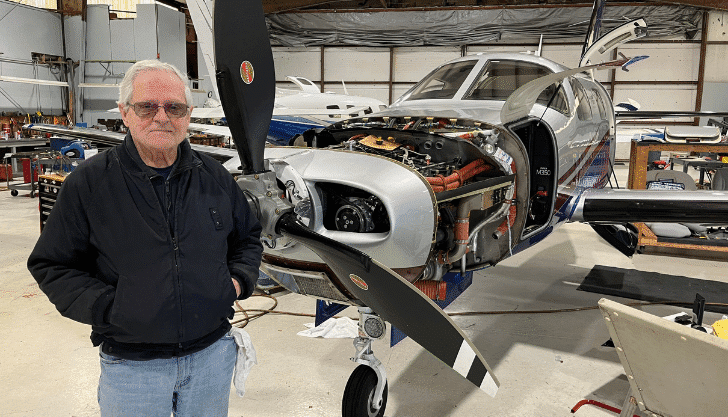
Don Harrington services all types of piston and turbo engines for Shoreline Aviation.
Don, from Dorchester and Boston, moved to Hanover, which he served for 25 years as a firefighter, while still in the Reserve. Reserve service is normally assigned to a weekend a month and two weeks of training a year. He was ordered back to active duty at the time of the Blizzard of ’78, as well as for hurricanes and floods. “We were the only ones allowed to fly in the area,” he said, “flying medical and blood supplies around New England. I was still working for Air New England at that time. State Police assisted me driving to the base during the storm.”
Don, who is married with three children and three grandchildren, retired from firefighting service in 2011. “I was out of aviation for a while, but I always liked aircraft and wanted something to do when I left the Fire Department. They were kind enough here to take a chance on me.”
An A&P license is lifetime, Don explained. “So, you get to know the type of aircraft in the manual,” he said. “The maintenance itself doesn’t change. If you know how to fix an airplane, you know how to fix an airplane, I was told.”
Nevertheless, he says he experienced a learning curve going into general aviation. “My background was with the airlines – the ‘big iron’ as it’s called.” Among his duties at Shoreline, “I service and repair aircraft as they come in – Pipers, Cessnas, Beechcraft, all types of piston and turbo engines,” he said. “And I do occasional work on Shoreline’s aircraft.”
Don says he’s carried over military experiences in his post-military life, partly by paying attention to detail.
“The main lesson was, don’t lose your cool, don’t panic,” he said. “Do what you’re trained to do. The fire service was the same way – hands on, difficult; you learn to keep your cool.”
Back to News